
George Washington Dollar vs. Other Presidential Coins — Which Holds More Value?
The George Washington dollar opened a new chapter in U.S. modern coinage. Released in 2007, it became the first issue of the Presidential $1 Coin Program. Each dollar issued honored American presidents in order of service
Although the coin looks golden, it contains no gold. The metal alloy gives it a bright tone that resembles gold but consists mostly of copper and nickel. This dollar gained public attention for both its design and its errors. But beyond errors, the coin marked the start of a 10-year program that reshaped how Americans viewed collectible dollar coins.
But here the question remains: how does the George Washington Dollar rarity and value compare with other Presidential dollars?
George Washington Dollar Overview
The coin honors the first U.S. president and sets the standard for the entire Presidential $1 series. It introduced new features, such as edge lettering, that hadn’t been used since the early 1800s.
Coin Main Features
| Feature | Description |
| Year of Issue | 2007 |
| Series | Presidential $1 Coin Program |
| Composition | 88.5% copper, 6% zinc, 3.5% manganese, 2% nickel |
| Weight | 8.1 g |
| Diameter | 26.5 mm |
| Edge | Lettered — “In God We Trust,” “E Pluribus Unum,” year, mint mark |
| Designers | Joseph Menna (obverse), Don Everhart (reverse) |
| Mint Marks | P (Philadelphia), D (Denver), S (San Francisco Proof) |
The obverse shows a detailed portrait of George Washington. The reverse depicts the Statue of Liberty with “United States of America” along the rim. The edge carries inscriptions, a mint mark, and the year — a modern revival of early coin traditions.

Other Presidential Coins of 2007
The Presidential $1 series started with four issues in 2007. Each honored a different early president and had the same metallic composition but different portrait on the obverse.
John Adams Dollar (Second Issue)
The John Adams dollar followed the Washington issue and was released in May 2007. It quickly became known for its minting flaws. Many coins showed double edge lettering — letters struck twice or partially overlapping.
- Common value: $1–$2 in circulation.
- Double edge lettering error: $100–$200 depending on grade.
- Proof version (S mint): around $10–$20.
Collectors treat this coin as a major part of early Presidential series history due to its visible minting variations.
Thomas Jefferson Dollar (Third Issue)
Released in August 2007, this coin honors the third U.S. president, Thomas Jefferson. The obverse shows his portrait created by engraver Joseph Menna, with “Thomas Jefferson”, “3rd President”, and “1801–1809” inscriptions.
- Circulated examples: around $1.
- Uncirculated: $3–$10.
- Proofs: $15–$25.
- Rare misaligned edge lettering: up to $75.
These coins are easy to find but they are still attractive to people collecting full 2007 sets.
James Madison Dollar (Fourth Issue)
Issued in November 2007, this coin depicts James Madison, the “Father of the Constitution”. The obverse shows his portrait by Joel Iskowitz and Don Everhart. The reverse again presents the Statue of Liberty motif common to the series. Edge inscriptions include the year, mint mark, and mottoes.
- Circulated: $1.
- Uncirculated: $5–$15.
- Proofs: $10–$25.
High-grade Madison dollars (MS67+) are scarcer and may reach $80–$100 at auction.
2007 Presidential $1 Coin Summary
| Coin | Mint Marks | Known Errors | Typical Value Range |
| George Washington | P, D, S | Missing Edge Lettering, Double Edge | $1–$1,200 |
| John Adams | P, D, S | Double Edge Lettering | $1–$200 |
| Thomas Jefferson | P, D, S | Weak or Tilted Edge Lettering | $1–$75 |
| James Madison | P, D, S | Minor Edge Variants | $1–$100 |
Comparative Value — Washington vs. Other Presidents
Collectors view the George Washington Dollar as the most symbolic coin of the series. It differs because it was the first, the most publicized, and the most error-prone issue.
Main differences that affect value:
- Rarity of errors: The “Godless Dollar” is unique to Washington’s release.
- Public recognition: As the first coin, it received massive media attention.
- Grading distribution: More high-grade Jefferson and Madison coins exist, lowering their premium.
While Washington dollars are common in circulation, top-graded or error-certified pieces sell for hundreds. The later 2007 issues trade close to face value if it doesn’t come to proof or error versions.
By the way, complete 2007 Presidential sets with all four coins in proof condition retain steady demand, often sold for $50–$80 in original Mint packaging.
Notable Errors and Varieties (2007 George Washington $1)
Edge lettering on the first 2007 release was applied in a separate step. High speeds and new equipment produced several repeatable mistakes. Most were seen on 2007-P coins,fewer on 2007-D. The main error pieces you can see in the table below.
| Error type | Where found (issue/mint) | How to spot | Notes and typical value (2025) |
| Missing edge lettering (“Godless Dollar”) | Mostly 2007-P; rarer in 2007-D | Edge is completely smooth — no date, mint mark, E PLURIBUS UNUM, or IN GOD WE TRUST | Most collected Washington variety. $100–$1,200 depending on grade; MS66+ brings the top range. |
| Double edge lettering (over-run through the machine twice) | Seen on Washington P/D, but far less often than on the later Adams dollar | Letters overlap or show a second, offset set around the edge | Premium when seen and evenly spaced. ~$50–$200 on Washington coin. |
| Weak/partial edge lettering | 2007-P and 2007-D | Letters look shallow, broken, or fade out mid-edge | Results from low pressure or clogged dies. ~$25–$75; higher if the weakness is visible and the coin grades MS65+. |
| Upside-down edge orientation (Position A/B) | Normal on all 2007 dollars from both mints | When the obverse is upright, the edge text may read either right-side-up or upside-down | Not entirely error piece; small or no premium unless paired with another error. |
| Off-center strike | P/D circulation pieces | Part of the design is missing; a blank crescent shows at the rim | The more the off-center shift, the higher the value. ~$80–$250+. |
| Blank planchet | P/D; rare in original U.S. Mint packaging | Plain golden-colored disc with no design; weight ~8.1 g | Collectible as a mint mishap. ~$200–$400; certified pieces sell best. |
Checks that prevent mistakes
- Proofs from San Francisco (2007-S) do carry edge lettering; a proof without it would be an extraordinary error — submit for certification.
- Many raw coins advertised as “missing lettering” actually have very weak lettering, so examine these coins carefully under a sharp light and use 5–10× magnification.
- For double lettering, look for a second, offset set of characters — not simple shadowing or cabinet rub.
Market Value and Collector Demand
The 2007 Presidential $1 series continues to attract collectors because most pieces remain affordable while some error or proof variants rise in value. In the table below you can see and compare the George Washington Dollar with the other 2007 issues to check how much the status, errors and condition affect price.
Average Market Values (2025)
| Coin (2007) | Circulated (P/D) | Uncirculated (MS60–MS65) | High Grade (MS67+) | Proof (S Mint PR69–PR70) | Typical Error Value | Notes |
| George Washington | $1 | $3 – $15 | $25 – $60 | $40 – $60 | $100 – $1,200 | First coin of series, “Missing Edge Lettering” most famous error |
| John Adams | $1 | $2 – $12 | $20 – $45 | $35 – $55 | $50 – $250 | “Double Edge Lettering” common error, strong secondary demand |
| Thomas Jefferson | $1 | $2 – $10 | $18 – $40 | $30 – $50 | $30 – $150 | Small strike varieties between P and D; collectors prefer MS67+ pieces |
| James Madison | $1 | $3 – $10 | $15 – $35 | $25 – $45 | $25 – $150 | Most common of 2007 issues; affordable entry coin for starting |
Auction Highlights
- 2007 P George Washington $1 MS65 was sold for $575 on February 13, 2008 (Heritage Auctions).
- 2007 P John Adams $1 MS64 was sold for $2,300 on September 11, 2009 (Heritage Auctions).
- 2007 P Thomas Jefferson $1 MS68 was sold for $35 on December 29, 2020 (eBay).
- 2007 P James Madison $1 MS68 was sold for $61 on December 27, 2016 (Heritage Auctions).
Even though millions were minted, only a small number remain in pristine state. Proofs from San Francisco Mint remain the most stable investment in the series because of their mirror fields and limited issue.
Edge errors (especially on the Washington and Adams dollars) are still the main driver of higher prices, while Jefferson and Madison issues attract collectors, who are looking for affordable, high-grade examples.
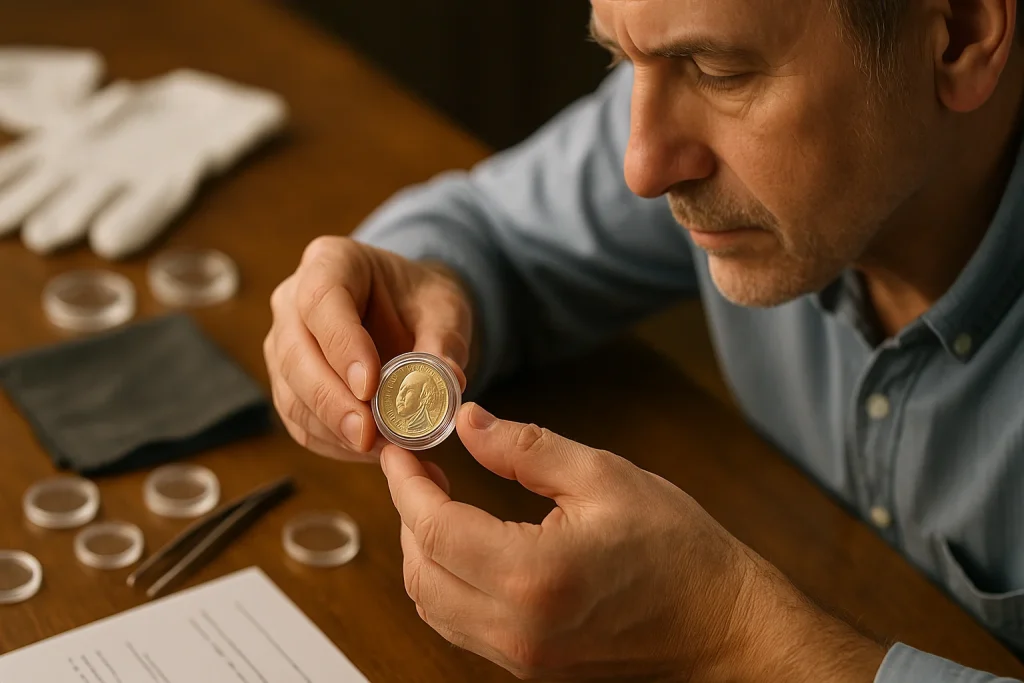
Collector Tip: When considering a coin from this series, focus first on preservation and certification. Coins still sealed in Mint sets, original tubes, or slabs by reputable services hold up better. And avoid pieces with obvious wear, cleaning marks, or friction damage — these conditions reduce value even for early program issues.
Preservation, Grading, and Authentication Tips
Proper care determines long-term value. Even modern dollars lose appeal if scratched or cleaned.
Main rules for storage:
- Keep coins in hard plastic capsules or PCGS/NGC holders.
- Never polish or rub pieces. Cleaning removes mint luster and reduces resale potential.
- Hold coins by edges only (to avoid dirt from your hand on the coins’ surfaces).
- Store in dry, temperature-controlled areas to prevent toning.
Consider also submitting a coin to professional grading to confirm its authenticity and grade and make sales easier. Coins certified as MS67 or higher see much higher interest. For raw coins, use a magnifying glass to inspect edges and surfaces.
The Future of the Presidential Dollar Series
The Presidential $1 Coin Program ended in 2016, but its influence remains strong.
The George Washington Dollar continues to anchor the entire series in collector discussions.
Several trends shape its modern relevance:
- Complete mint sets (2007–2016) attract collectors and beginners learning the minting nuances.
- Edge-lettering analysis has grown into a separate niche of U.S. coin study.
- Certified errors from early years increase slowly in value.
- The series encouraged renewed public interest in historical designs.
Modern collectors now rely on digital records. Apps like Coin ID Scanner simplify identification by photo, showing mint marks, year, and market data instantly. Use the app to prevent mix-ups between coin varieties and easier organize collections digitally for long-term tracking.
Final Outlook
The George Washington Dollar remains a foundation piece of the Presidential $1 series. From a collector’s view, the coin has limited financial growth but strong educational and historical value. For investors, returns come only from certified proof or error examples. For hobbyists, it’s a good option to study mint processes and early design changes of the 21st century. So, install the app and start your own Presidential collection.